

Three Treasures Daily Reset: A Gentle Daily Practice for Jing, Qi and Shen
- Dr. Guadalupe Vanderhorst Rodriguez D.Ac, L.Ac

- 5 days ago
- 7 min read
Free Wellness Guide from Kicotan Wellness
What if creating greater balance in your day didn't require an hour-long wellness routine?
Sometimes the most meaningful practices are the simplest: a few minutes to become still, breathe intentionally, move gently, and reconnect with yourself.
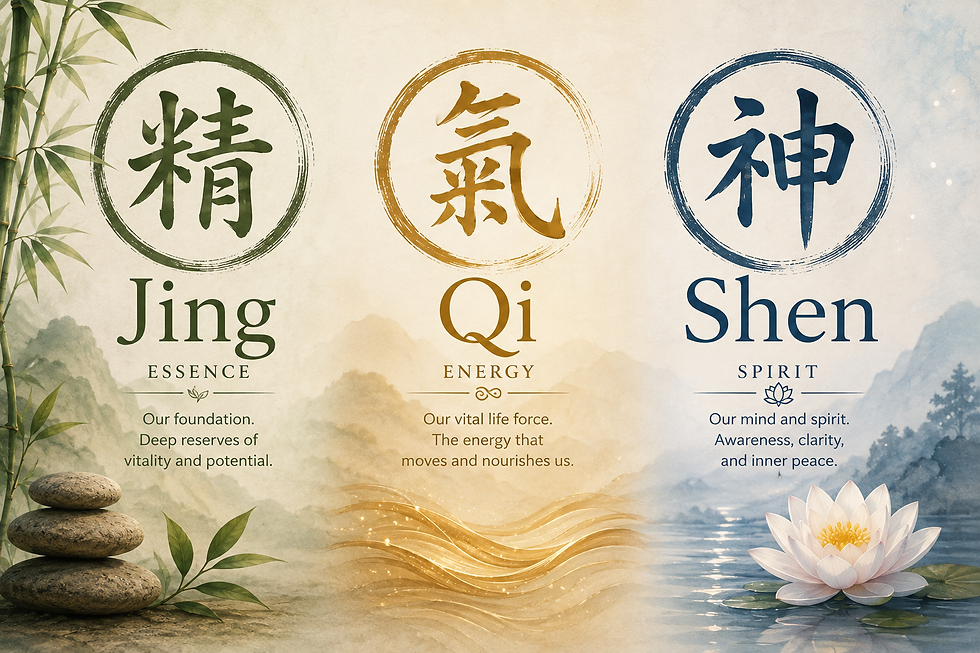
The Three Treasures Daily Reset is a gentle wellness practice inspired by the traditional Chinese concepts of Jing, Qi and Shen. These Three Treasures offer a useful framework for thinking about our foundational resources, everyday vitality, and mental-spiritual presence.
This free guide introduces a simple daily practice you can use in the morning, during an afternoon break, or at the end of a demanding day.
The intention isn't to accomplish more.
It is to create a few quiet minutes to restore, move and center.
What Are the Three Treasures: Jing, Qi and Shen?
In traditional Chinese thought, Jing (精), Qi (氣) and Shen (神) are commonly described as the Three Treasures.

Although these concepts are much richer than any simple English translation, they can provide a practical framework for everyday wellness.
Jing — Your Foundation
Jing is often translated as essence. Within traditional Chinese medicine and Daoist thought, Jing is associated with our foundational constitution, development, reproduction, aging and reserves.
For a modern daily wellness practice, you might think of Jing as a reminder to ask:
Am I protecting and replenishing my personal resources—or constantly depleting them?
Rest, adequate sleep, appropriate nourishment, pacing yourself and respecting your body's limits can all become part of a Jing-centered lifestyle.
Your Jing practice reminds you:
You do not have to spend all of your resources today.
Qi — Your Vitality and Movement
Qi is one of the most recognized concepts in Chinese medicine and philosophy.
It is often translated as vital energy, although the traditional meaning encompasses a much broader range of processes and functions.
Within a daily wellness practice, Qi can represent movement, breath, activity, rhythm and vitality.
Consider how different you feel after sitting at a computer for several hours compared with taking a short walk outside, stretching your body, practicing Qi Gong or simply taking several comfortable breaths.
The Three Treasures Daily Reset uses gentle movement and breathing as an opportunity to interrupt prolonged stillness and reconnect with the body.
Your Qi practice asks:
What helps me feel more alive, mobile and engaged with my day?
Shen — Your Mind and Spirit
Shen is commonly associated with the mind, spirit, consciousness and awareness.
When life becomes busy, the mind can remain active even when the body has stopped moving.
You may be sitting quietly while mentally reviewing tomorrow's responsibilities, yesterday's conversation and today's unfinished tasks.
A Shen practice creates intentional space for stillness.
Instead of asking your mind to solve another problem, you give yourself a few minutes simply to observe and become present.
Your Shen practice asks:
Where is my attention right now?
Why Practice a Daily Three Treasures Reset?
Modern wellness can become surprisingly complicated.
There are exercise programs, nutrition plans, meditation apps, supplements, tracking devices and endless recommendations about what we should be doing.
The Three Treasures Daily Reset takes a different approach.
Rather than adding another demanding routine, it encourages you to return to three fundamentals:
Jing — Restore.Qi — Move.Shen — Center.
These three practices can become a simple framework for checking in with yourself throughout the day.
The goal is not to diagnose or treat a health condition. It is to cultivate greater awareness of your rest, movement, breathing, attention and daily rhythms.
The Three Treasures Daily Reset: A Simple 10-Minute Practice
You can practice this routine standing or seated, depending on your comfort and mobility.
Choose a quiet location and remove unnecessary distractions.
You don't need special clothing, equipment or an elaborate meditation space.
You simply need a few minutes.
Step 1: Arrive — 1 Minute
Begin by becoming still.
Place both feet comfortably on the floor or ground.
Relax your shoulders.
Unclench your jaw.
Allow your hands to rest naturally.
Don't immediately try to change anything.
Simply notice how you feel.
Ask yourself:
What am I bringing into this moment?
Step 2: Support Jing — 3 Minutes
Your first practice is about conservation and restoration.
Place your hands gently over your lower abdomen.
Allow your breathing to become comfortable and natural.
Rather than forcing yourself to take exceptionally deep breaths, simply allow the breath to slow.
With each exhalation, imagine releasing unnecessary effort.
Notice where you're holding tension.
Then ask:
What does my body need today?
Perhaps the answer is rest.
Perhaps it is better nourishment.
Perhaps you need to stop overscheduling yourself.
Perhaps you simply need permission to move more slowly.
Your Jing reset is not about doing more.
It is about recognizing your resources and using them wisely.
Daily intention: I respect my body's need for restoration.
Step 3: Activate Qi — 3 Minutes
Now introduce gentle movement.
Slowly raise your arms as you inhale comfortably.
Lower them as you exhale.
Repeat several times without forcing the movement or breath.
Next, gently shift your weight from one side to the other if standing. If seated, gently move your arms or shoulders within a comfortable range.
Imagine the movements being smooth rather than hurried.
Pay attention to the relationship between breath and movement.
This is not about burning calories or completing repetitions.
It is an opportunity to move after periods of sitting and bring awareness back into your body.
Daily intention: I allow movement and breath to bring rhythm into my day.
Step 4: Settle Shen — 2 Minutes
Allow your movements to stop.
Sit or stand quietly.
Let your breathing return to its natural rhythm.
Instead of following every thought that appears, simply notice it and return your attention to the present moment.
Listen to the sounds around you.
Notice your breathing.
Feel your feet touching the floor.
Observe your body without judging what you notice.
For these two minutes, there is nowhere else you need to be.
Daily intention: I return my attention to the present.
Step 5: Integrate the Three Treasures — 1 Minute
Finish by bringing your awareness back to all three treasures:
Jing — How are my reserves?
Qi — How is my vitality and movement?
Shen — How is my mind and inner presence?
Then choose one small action to support yourself today.
It might be:
Going to bed 30 minutes earlier to support Jing.
Taking a 10-minute walk to encourage movement and Qi.
Sitting quietly without your phone for five minutes to settle Shen.
This is where ancient philosophy becomes practical daily wisdom.
The Three Treasures Daily Check-In
One of the easiest ways to incorporate this philosophy into everyday life is to ask yourself three questions.
JING
What do I need to restore today?
QI
What do I need to move today?
SHEN
What do I need to quiet today?
You don't need complicated answers.
Sometimes your response might simply be:
Rest. Walk. Breathe.
That can be enough.
Morning, Midday or Evening: When Should You Practice?
There isn't one perfect time.
A morning Three Treasures Reset can help you begin your day intentionally rather than immediately reacting to emails, news and responsibilities.
A midday reset can provide a useful transition after prolonged sitting or concentrated work.
An evening reset can help create a boundary between the activity of the day and your time for rest.
Experiment and discover what fits naturally into your life.
Consistency is more useful than trying to create the perfect ritual.
A Gentle Approach to Everyday Wellness
One of the most valuable lessons within the Three Treasures framework is that wellness isn't only about what you accomplish.
It is also about what you preserve, cultivate and nourish.
Jing reminds us to respect our resources.
Qi reminds us that life requires movement and rhythm.
Shen reminds us to care for the quality of our attention and inner life.
Together, they offer a simple question for everyday living:
What would help me feel more restored, energized and centered today?
Your answer may change from one day to the next.
And that is precisely why a daily reset can be so valuable.
Get the Free Three Treasures Daily Reset Guide
If you'd like to begin incorporating the principles of Jing, Qi and Shen into your daily wellness routine, the Three Treasures Daily Reset: A Gentle Daily Practice for Jing, Qi & Shen provides a simple place to begin.
Use it as your morning ritual, midday wellness break or evening practice.

Inside the Free Guide
You'll discover a gentle introduction to Jing, Qi and Shen, a simple Three Treasures self-check-in, mindful breathing and movement practices, reflection prompts, and an easy daily routine you can return to whenever you need to reconnect with yourself.
Restore your Jing. Cultivate your Qi. Center your Shen.
Get your FREE Three Treasures Daily Reset Guide from Kicotan Wellness.
Wellness Disclaimer
The information in this article and guide is provided for general educational and wellness purposes.
Traditional concepts such as Jing, Qi and Shen are presented within their historical and philosophical context and should not be interpreted as biomedical diagnoses. The practices described are not intended to diagnose, treat, cure or prevent disease or replace individualized medical care.
References
You can place this section at the end of your “Three Treasures Daily Reset: A Gentle Daily Practice for Jing, Qi and Shen” blog article.
National Center for Complementary and Integrative Health. Traditional Chinese Medicine: What You Need to Know. National Institutes of Health. Provides an overview of Traditional Chinese Medicine, including its historical foundations and contemporary use.
National Center for Complementary and Integrative Health – Traditional Chinese Medicine
National Center for Complementary and Integrative Health. Tai Chi: What You Need to Know. National Institutes of Health. Reviews research and safety information related to Chinese mind-body movement practices.
Kohn, L. (2008). Chinese Healing Exercises: The Tradition of Daoyin. University of Hawai‘i Press. A scholarly examination of traditional Chinese practices involving breathing, movement, meditation, and cultivation of the body.
Kohn, L. (2005). Health and Long Life: The Chinese Way. Three Pines Press. Explores traditional Chinese approaches to cultivating health, vitality, balance, and longevity.
Yang, Jwing-Ming. (1997). The Root of Chinese Qigong: Secrets of Health, Longevity & Enlightenment. YMAA Publication Center. Discusses foundational Qigong concepts, breathing, Qi cultivation, and traditional Chinese approaches to mind-body practice.
Cohen, K. S. (1997). The Way of Qigong: The Art and Science of Chinese Energy Healing. Ballantine Books. Introduces the history, philosophy, breathing exercises, meditation, and movement practices associated with Qigong.
Suggested Research Note
Research Note: Jing, Qi, and Shen are traditional concepts rooted in Chinese medicine, philosophy, and cultivation practices. Their meanings are broader than simple English translations such as “essence,” “energy,” and “spirit.” In the Three Treasures Daily Reset, these concepts are used as a traditional wellness framework for reflection, gentle movement, breathing, rest, and mindful awareness rather than as biomedical diagnoses or medical treatments.


Comments